Muscle Adhesions & Why They Occur
Andy Curtiss - BEXSc, NASM - CPT, CES, PES; ACE - CMES; SNC, CNLP
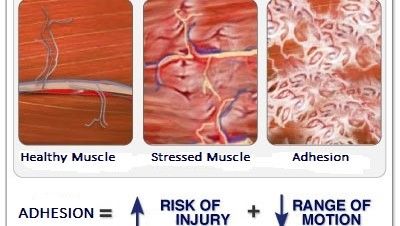
Overview of the body’s healing response
When tissue becomes damaged the body is equipped with a natural healing response to minimize and repair the damage that has occurred. Damage occurs, receptors within the skin and endothelial (innermost) tissues of capillaries and veins detect the damage and set off a cascade of reactionary events. The immediate area is flooded with plasma which aids in coagulation and clotting. White blood cells, Helper T’s, Macrophages, and other natural infection fighters are rushed to the site of injury. Inflammation occurs to constrict the vessels and surrounding tissues to aid in reducing fluid and blood loss and in closing the wound. Depending on the size of the wound clotting may occur in as early as 7 minutes. When clotting is achieved the proteins delivered to the site via blood undergo a conversion and new tissue is generated. Scar tissue, collagen, and elastin form a mesh which draws the wound together as the new tissue is remodeled and matured. This happens superficially (on the skin), subcutaneously (under the skin), on muscle tissue, and internally.
Soft tissue tears
Soft tissue tears such as muscle strains, and tears, strains, sprains and tears of the tendons and ligaments can occur for a variety of reasons. These injuries may occur as the result of athletic injuries or normal every day, routine functions. These injuries can occur as a result of trauma or even exercise. The premise behind hypertrophy (growth) due to weight training is based on the loading of the muscles causing microtears and the rebuilding (remodeling) of new tissue. When a sprain or tear occurs the injured person experiences pain, inflammation, and tenderness at the site of injury. This is due to the body’s healing response. Many muscle tears are healed in a matter of days to a couple weeks. Most require minimal reduction of activity based on the degree of injury.
Post-acute injury adhesion
Adhesions often referred to as “Muscle Knots”, are the product of the healing response. The tissue becomes damaged. The cascaded healing response takes place and eventually new tissue is remodeled. Much like a cut that forms a scar, damaged muscle tissue forms scarring. The fascia that surrounds the muscle is also pulled together during the healing process and sometimes becomes amalgamated with the scarring and new remodeled tissue which forms a fistula (Knot). Muscle fascia (Myofascia) is a thin viscous tissue that holds the sarcolemma of the muscles together aiding in the muscle’s ability to contract. Without the myofascia there would be no structural support allowing the actin and myosin between muscle filaments to contract against each other resulting in muscle contraction. However, once a muscle knot occurs it leads to the contracture and shortening of the affected muscle. This alters length tension relationships, posture, and movement.
Muscle knots and adhesions can cause impingement and lead to chronic posture distortion, movement and muscle imbalances. Sometimes, adhesions place muscles along the kinetic chain under a state of constant tension due to shortening. In places like the upper shoulder or neck it often leads to neck pain and headache. In the calves this can lead to heel pain and Plantar Fasciitis. In many cases when a muscle is injured or in the event of another injury it can lead to avoidance behavior and altered movement in the early stages of the healing response. This limited range of motion can lead to adhesion in itself. This is because the myofascia becomes stuck to itself and forms a fistula. Eventually and without proper post injury rehabilitation, it can lead to chronic shortening. If the range of motion is not restored it may lead to injury.
We know that an acute injury can lead to avoidance behavior, reduction in range of motion, the formation of a fistula, shortening of the muscle, and adhesion. However, when a muscle is repeatedly used in a manner that does not permit full range of motion, the muscle can become shortened. For example, when women where high heeled shoes on a daily basis, the ankle and foot are in a prolonged and excessive state of plantar flexion. This results in the sticking of the myofascial tissue, and without correction, overtime becomes spasmatic and forms adhesion. This results in the further shortening of the muscle, an alteration of the length tension relationship, and impaired contractile ability. This shortening of the muscles of the gastrocnemius and soleus (calf muscles) places the tendons in a state of vulnerability. The result is a constant pulling on the connected plantar fascia at the heel and beneath the foot and heel pain.
Overuse injuries often occur in athletes who perform repetitive movements such as in tennis, baseball pitchers, swimmers, and others. Additionally, individuals who work in sedentary settings such as in offices, people who sit for more than 3 hours at a time and those who perform clerical work such as working with keyboards; also, frequently fall prey to overuse injuries. Overuse injuries are common in the manual labor industry or any other field where repetitive motion occurs. Muscle adhesion is not the only type of overuse injury. As previously stated, chronic muscle shortening alters length tension muscle relationships and places tendons in a vulnerable state. Additionally, overuse can cause inflammation and wear on tendons and ligaments resulting in pain and avoidance behavior. As described earlier in this article, avoidance behavior leads to altered range of motion and can lead to further muscle shortening. Chronic shortening can lead to the formation of adhesions. This cycle often repeats itself.
In summary
This article builds from previous articles about the body’s healing response and the cumulative injury cycle. It is not intended to be an all-encompassing article. The purpose of this piece is to inform the reader about the mechanism of injury as it pertains to adhesions, muscle tears, sprains, and overuse injuries. Furthermore, this article was written to help the reader become more informed and educated on the function of the body’s healing response and to apply the cumulative injury cycle in practical terms. For those interested in engaging in a corrective exercise protocol or for trainers interested in pursuing a specialty in corrective exercise this article may prove especially useful.
“Healthy citizens are the greatest asset any country can have.”
― Winston S. Churchill
SPONSORED ADS
Our world is changing faster than many can keep up. “THE NEW NORMAL” Only it’s not new and it’s not normal. Society has been slowly put into retrograde by an elite class who wants to bring about “The fourth industrial revolution”. Like frogs in a slow boiling pot, society has become conditioned to ceding their individual rights, censorship, mindlessly obeying government and rejecting logic and reason. If you enjoyed this article and others on this site, you will also enjoy 1984 Redux Say Hello to Big Brother. The book was so accurate about the corruption in government and the international cabal of corporate globalists that Amazon banned 5-star reviews of it, shadow banned it and refused to abide by their contractual obligations to promote it. This is why the book can no longer be found in print and is ONLY AVAILABLE HERE.

Learn Anatomical and biomechanically effective, lethal self-protection techniques designed by a Special Forces soldier for a Special Forces Team. Combat Application Techniques: Principles of Destruction was designed for elite operatives to use in the caves, urban areas, and front lines of the Global War On Terror (GWOT) and is NOT a martial art. The system that was once ONLY taught to military, law enforcement, and civilians who were vetted by police background check is now available to you in this digital eBook. ONLY AVAILABLE HERE
Other Articles you may like
General Adaptation Syndrome & Specific Adaptation
Injury Prevention: Joint Injuries
From Static Stretching to Dynamic Exercises: Changing the Warm-Up
How to Correct Rucking Postural Deficiencies and Muscle Imbalance
Self-Myofascial Release for Trigger Point Release
Three Stages of The Body's Healing Process
Max U LLC is a 100 percent VA Disabled Combat Veteran Owned Small business. This blog is part of Max U's commitment to the consumer by providing education on health, wellness, and rugged individualism through teaching exercise science, and practical life skills free of cost. Although contribution it is not necessary, any donation to help keep the site running is helpful and appreciated.
.png/:/cr=t:0%25,l:0%25,w:100%25,h:100%25/rs=w:1280 "Scan the QR Code or Click the link to donate a monetary donation of your choice")
References
American Council on Exercise. (2015). Medical Exercise Specialist Manual. (F. James S. Skinner PH.D, Ed.) San Diego, CA, USA: American Council on Exercise.
Lippert Lynn S. PT, M. (2017). Clinical Kinesiology (6th ed.). Philadelphia, PA: F.A. Davis. Retrieved 2021 Maynard, J. (2015, Dec).
How Wounds Heal: The 4 Main Phases of Wound Healing. Shield Healthcare. Retrieved from https://www.shieldhealthcare.com/community/popular/2015/12/18/how-wounds-heal-the-4-main-phases-of-wound-healing/
Michael A. Clark, D. M., Scott C. Lucett, M. P.-C., & Brian G. Sutton, M. M.-C. (2014). NASM’s Essentials of Corrective Exercise. Burlington, MA: Jones & Bartlett Learning. Retrieved Jan 2021 Mosier, N. (2014, Jul 15).
Knots, Adhesions, and Trigger Points. Retrieved Jun 2021, from Amherst Wellness Center: https://www.amherstwellness.com/2014/07/knots-adhesions-trigger-points/ NASM. (2018).
NASM ESSENTIALS OF PERSONAL FITNESS TRAINING (6th ed.). (D. M.-C.-C.-C.-C. Micheal A. Clark, Ed.) Burlington, MA, USA: Jones & Bartlett Learning. Retrieved June 2020 NASM. (2019).
ESSENTIALS OF SPORTS PERFORMANCE TRAINING (2nd ed.). (M. N.-C.-C. Erin A. McGill, Ed.) Burlington, MA: National Academy of Sports Medicine. Retrieved Apr 2021 repair, T. p. (2022, Jan).
The pathology of healing and repair. Surgery (Oxford)(1). Retrieved from https://www.sciencedirect.com/science/article/pii/S0263931921002374 S., L. L. (2011).
Clinical Kinesiology and Anatomy (5th ed.). Philadelphia, PA: F.A. Davis Company. Retrieved Mar 2021 W. Larry Kinney, J. H. (2020).
Physiology of Sport and Exercise (7th ed.). Human Kinetics. Retrieved Dec 2020 WEISENFELD, M. F. (1981). Runner's repair manual. St. Martin's Press. Retrieved June 2021


